
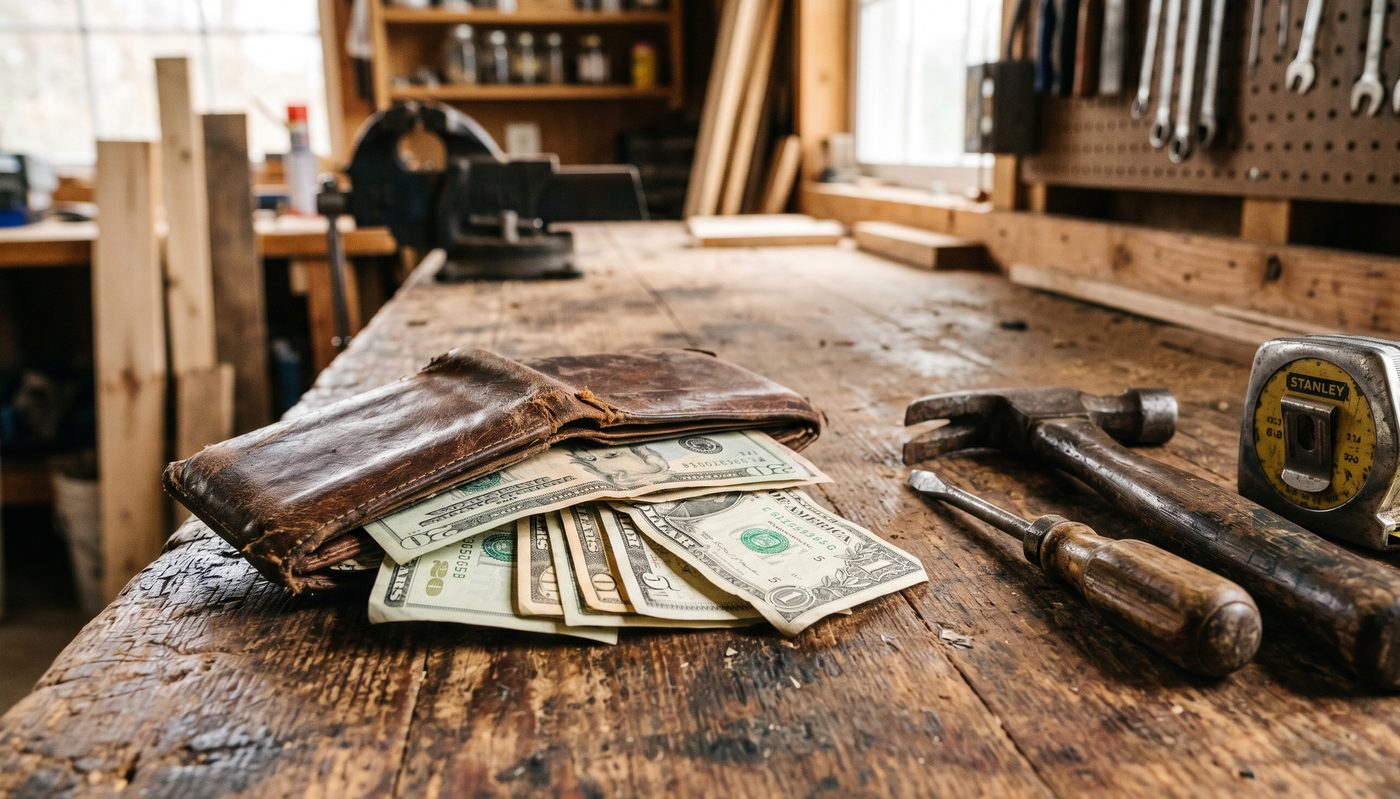
A 30-year financial accounting of the small household tasks families used to handle themselves — and the bill we’ve been quietly paying ever since we stopped.
There’s a quiet number that almost no family calculates, even though it lives in their bank statements every year.
If you took an average middle-class household and added up everything they spent over the last 30 years on household repairs, small construction, basic vehicle maintenance, and minor home improvements they paid someone else to do — the kind of thing two generations ago a homeowner would have handled themselves on a Saturday morning — the total would be somewhere between $38,000 and $62,000 in equivalent purchasing power, depending on the country.
That’s not a typo. That’s a real estimate, based on average annual home maintenance spending tracked by consumer spending surveys across English-speaking markets.
And here’s the part that hurts: at least 70% of that work is something a moderately handy person could have done themselves, with a few hundred dollars in tools, a handful of YouTube tutorials, and an afternoon’s patience.
Three generations ago, this work was done by the family. Two generations ago, it started slipping. Today, the slip has become a structural transfer of wealth out of households — about $1,200 to $2,000 per family per year, every year — going to handymen, contractors, and service technicians for tasks the homeowners themselves were perfectly capable of learning.
This article is the accounting. Eight specific things families have quietly stopped doing for themselves, what they’re paying for it now, and what it’s actually costing them over the long term.
1. Fixing a Leaky Faucet — $8 vs. $185
A faucet that drips is caused, in nine out of ten cases, by a worn $1 rubber washer or $3 cartridge inside the handle. It takes 20 minutes the first time you do it, 8 minutes after that.
Average cost to call a plumber for this: $185.
Frequency in an average home: roughly once every two years.
Lifetime savings if a homeowner just learned this: about $2,775 over 30 years.
We replaced this skill with the phone number of a plumber.
2. Replacing a Light Switch — $4 vs. $145
A standard light switch costs between $3 and $15 at any hardware store. Replacing one is a 20-minute job that involves turning off the breaker, unscrewing two screws, transferring the wires, and reinstalling.
Average cost for an electrician to swap a switch: $145, often with a minimum service call charge.
A typical home has 30+ switches, and the average homeowner replaces 5-8 of them over 30 years as switches wear out, get scratched, or get repainted.
Lifetime savings of doing this yourself: $700 to $1,150 over 30 years.
We replaced this skill with a $145 minimum service call.
3. Patching a Hole in Drywall — $12 vs. $250
Doorknobs leave dents. Kids leave dents. Furniture leaves dents. Every home accumulates between 6 and 15 small drywall holes over a 30-year occupancy.
A drywall patch kit costs $12. The repair takes about 30 minutes of active work plus drying time, and the result is invisible after paint.
Average cost for a drywall pro to repair a single small hole: $250.
Lifetime savings of doing this yourself: about $2,400 over 30 years.
We replaced this skill with the willingness to live with the dents until move-out.
4. Building a Shed or Outbuilding — $400 vs. $2,800
Most families need an outdoor structure at some point — a shed for tools, a small garden building, a chicken coop, a workshop. The materials for an 8×10 shed cost between $387 and $480 depending on lumber prices in your area.
Average price of a comparable pre-built or contractor-built shed: $2,800 to $4,200, plus delivery, plus assembly.
Difference: roughly $2,400 per shed.
The household used to assume this would be a Saturday project, the same way pioneer families assumed they’d raise a barn over a weekend with neighbors. Today, almost no family considers building it themselves the default.
If you’re at the point of seriously considering this, our review of a step-by-step shed-building guide that worked for first-time builders is a fair starting point — written by a father who, like most readers here, had never built one before either.
5. Changing the Oil in a Car — $25 vs. $85
A 5-quart jug of motor oil and a basic oil filter cost about $25. Changing your own oil takes 30 minutes once you’ve done it twice and have the right basic tools (a drain pan, a wrench, a few rags).
Average cost for an oil change at a quick-lube place: $85, plus the upsells they pressure you into (“your air filter looks dirty,” “we recommend the synthetic upgrade”).
Average driver does this 3-4 times per year for 30 years.
Lifetime savings: roughly $7,200 over 30 years.
We replaced this skill with a Saturday wait at the quick-lube.
6. Painting a Room — $80 vs. $1,200
A gallon of decent interior paint costs $35-50 and covers about 350 square feet. A small bedroom typically takes one gallon plus a few brushes and a roller — total materials around $80. Time investment: an afternoon plus drying.
Average cost for a contractor to paint a single bedroom: $1,200 to $1,800.
A typical home has 8-10 rooms, repainted on average every 7-10 years over a 30-year occupancy.
Lifetime savings: $15,000 to $25,000 over 30 years.
This is the largest single line item on the list. We replaced “Saturday painting in old clothes” with “painting contractor in clean overalls.”
7. Building Basic Furniture — $90 vs. $480
A simple wooden bookshelf, workbench, garden bench, or toy chest can be built for $40-100 in lumber and hardware. A few weekends of practice and you’re producing furniture that’s better than what’s at the big-box flat-pack store, lasts longer, and is exactly the size you want.
Average price of a comparable pre-built piece: $300-700.
A typical family buys 8-12 pieces of furniture over 30 years that they could have built themselves.
Lifetime savings: about $4,800 over 30 years.
We replaced this skill with assembly instructions for laminate particle board.
8. Teaching the Next Generation Any of It — Priceless
This is the one with no dollar amount.
The economic cost is not the deepest cost.
The deepest cost is that the children of households that paid for everything to be done never see anyone in their family doing these things. A 12-year-old whose father has never picked up a hammer in front of him does not grow up knowing what a hammer is for. He grows up assuming, in his bones, that fixing things is something other people do, for money.
By the time he becomes a parent, the chain is broken. He passes nothing down, because he was given nothing to pass down. His children, in turn, will pass nothing down. And the wealth transfer out of households continues — not just for the next generation, but for the generation after that.
This is the largest cost on the list, and it doesn’t show up on a credit card statement.
The 30-Year Total
Just the financial side, conservatively. Note that “DIY cost” includes the materials, parts, and tools you’d actually buy — it’s not zero, just much lower:
| Item | Cost outsourcing | Cost DIY (materials) | Net savings |
|---|---|---|---|
| Faucet repairs (15 over 30y) | $2,775 | $45 | $2,730 |
| Light switches (8 swaps) | $1,160 | $80 | $1,080 |
| Drywall patches (10 over 30y) | $2,500 | $120 | $2,380 |
| One shed | $2,800 | $400 | $2,400 |
| Oil changes (~105 over 30y) | $8,925 | $2,625 | $6,300 |
| Room paintings (~32 over 30y) | $38,400 | $2,560 | $35,840 |
| Basic furniture (10 pieces) | $4,800 | $900 | $3,900 |
| Total | $61,360 | $6,730 | $54,630 |
That’s the financial difference between two families with the same income, the same house, the same kids, and the same number of years — one of which kept the skills, and one of which outsourced them.
$54,630 in net savings over 30 years. Roughly $1,820 per year. Roughly the cost of one decent family vacation, every single year, that one family takes and the other doesn’t — because the other family is paying it to handymen and contractors.
And note: that’s after subtracting the actual cost of doing it yourself. The materials, the parts, the tools, the paint — all included. The DIY family still spent $6,730 over 30 years. They just spent it on lumber and washers, not on labor charges.
Why It Happened
We don’t think any individual family chose this. It happened the way most slow erosions happen: one decision at a time, each one reasonable in isolation.
The 1970s saw the rise of disposable culture. The 1980s saw the explosion of consumer credit. The 1990s saw labor specialization push household work toward “professionals” with insurance and certifications. The 2000s saw an entire generation of children grow up without garage workshops, because both parents now worked full-time and the garage became storage.
By the 2020s, the average homeowner has the financial means to handle a $185 plumber visit but doesn’t have the muscle memory of changing a washer. Both states are real. Neither is anyone’s fault.
But the cost is real too — and unlike most invisible costs in modern life, this one is reversible.
How to Reverse It
You don’t reverse $54,000 of accumulated outsourcing in one weekend. But you can reverse it one skill at a time, starting with the smallest one and working up.
Our past articles have laid out specific starting points:
- The $50 starter tool kit that handles 90% of household problems
- Five basic home repairs worth learning, ranked by frequency
- How to teach your kids to use tools, age by age, project by project
- Building a simple workbench — the gateway project
The math works at any scale. Saving the family $1,000 a year is meaningful. Saving $1,357 a year for 30 years compounds into a different financial trajectory entirely.
But the more important math, the one that doesn’t appear on the spreadsheet, is what gets passed to your kids. A child raised in a house where things get fixed will fix things for the rest of their life. A child raised in a house where things get phoned in will phone things in for the rest of their life.
That’s the real number we’ve been quietly paying.
One Last Thought
There is a particular kind of pride that has gone missing from a lot of homes — the pride of looking at a small repair and saying “yeah, I can handle that.” And then handling it.
It is not pride about saving money. The money is real, but it’s not the source of the pride.
The pride is about a particular kind of self-respect that comes from refusing to outsource your basic capability. It’s the difference between feeling like a customer in your own life and feeling like a homeowner in it.
You can buy that pride back, slowly, one Saturday at a time.
It costs less than most people think. And it pays back in ways that aren’t only financial.
Prepared Family Press publishes practical guides for households that want to stay capable. We believe self-reliance at the household scale isn’t an ideology — it’s just the ordinary, quiet maintenance of a capable life.