
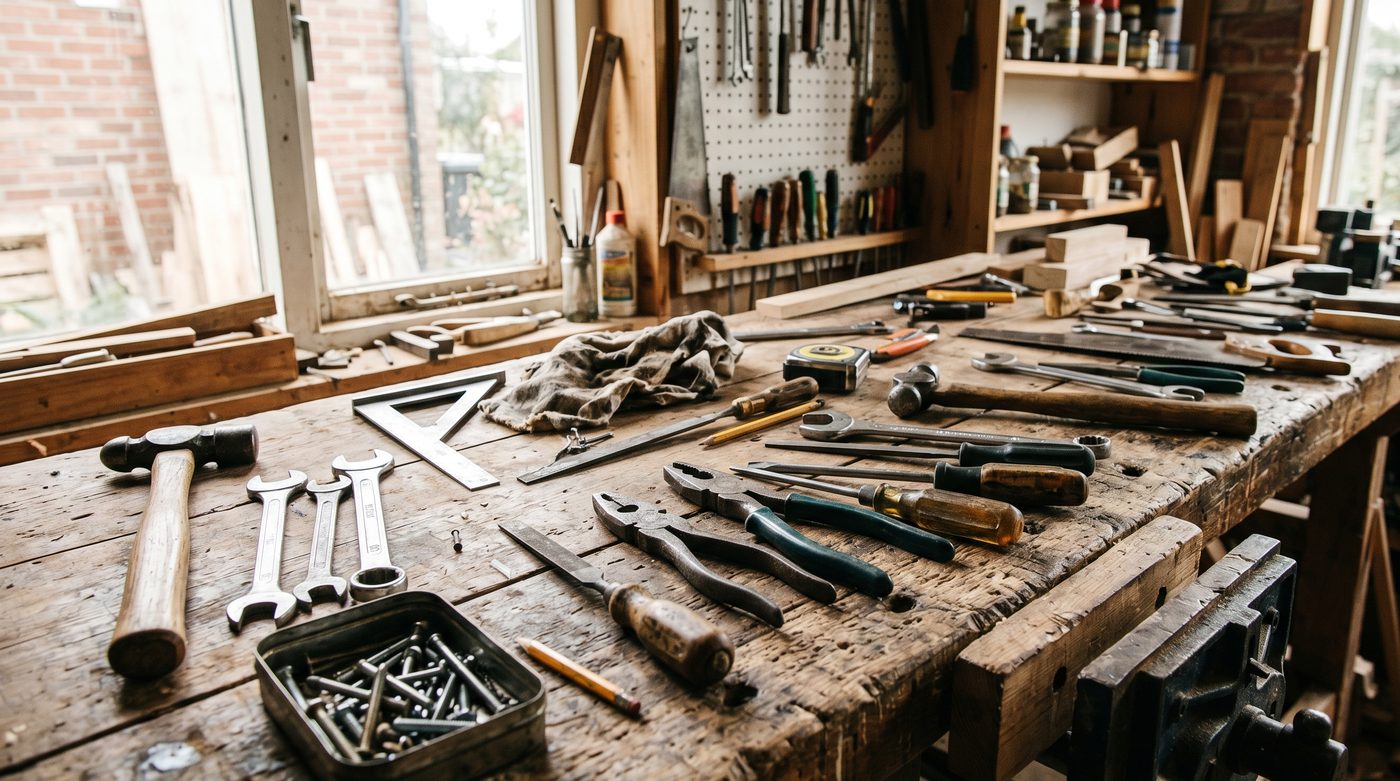
Most American homeowners pay tradesmen for repairs they could do themselves with a small set of basic tools. Here’s what to buy, what to skip, and how to put together a kit that solves nine out of ten common household problems.
Last Saturday, my neighbor paid a handyman $180 to come hang a curtain rod, tighten the kitchen faucet, and replace a light switch.
The whole job took the handyman thirty-five minutes. The total cost in tools — if my neighbor had owned them — would have been about $42.
I’m not saying that to make my neighbor feel bad. He’s a good guy who works in finance and would rather pay someone else to deal with it. That’s a perfectly valid choice.
But here’s the thing: most American homeowners never pay $180 for one job. They pay $180, and $90, and $250, and $310, scattered across a year of small annoyances, until they’ve spent $1,500 on jobs that, with the right starter kit and a YouTube video, would have taken a couple hours of their own time.
The tools that handle nine out of ten of these jobs cost about $50 total. Here’s what they are, in the order I’d buy them.
Why Most Homeowners’ Tool Drawers Are a Disaster
Walk into the average American home and ask to see the tool collection. You’ll usually find one of three things:
The Junk Drawer: A handful of mismatched screwdrivers, a pair of pliers from 1996, two batteries that don’t fit anything, and a tape measure with the locking mechanism broken.
The Inherited Kit: A toolbox passed down from a father or grandfather, half-full of specialty tools the current owner doesn’t know how to use, and missing all the basics.
The Costco Special: A 200-piece tool set in a plastic case, bought on sale, where 195 of the pieces are useless and the 5 you actually need are made of the cheapest possible steel.
What almost nobody has is what they actually need: a small, deliberate set of well-chosen tools, organized in one place, that handles ordinary household problems.
That’s what we’re going to fix.
The Core Six: $50 Total
You don’t need a workshop. You need six tools.
1. A Good Cordless Screwdriver — ~$25
This is the single best $25 you can spend on your house. A small, lightweight cordless screwdriver — not a heavy drill, just a battery-powered driver — handles assembly, disassembly, hinge tightening, hardware swaps, and roughly 60% of all household tasks.
Buy one with a removable battery so you can replace it later. Avoid the ones that come with a hundred bits — you’ll only ever use four or five. A simple kit with Phillips, flathead, and Torx bits is enough for most homes.
2. A Real Tape Measure — ~$8
The cheap ones from the dollar store don’t lock, don’t retract cleanly, and read inaccurately past four feet. Spend eight dollars on a 25-foot tape measure with a locking blade. You’ll use it more than any other tool you own — measuring furniture before buying, picture frames, curtain rods, room layouts, replacement parts.
3. A Hammer — ~$10
A 16-ounce claw hammer with a fiberglass handle. That’s it. Don’t overthink this. Don’t buy a five-pound demolition hammer. A standard claw hammer drives nails, pulls nails, and gives you something to tap stubborn things with. Lasts thirty years.
4. Channel-Lock Pliers — ~$8
This is the one tool most homeowners don’t realize they need. Channel-lock pliers (also called slip-joint or tongue-and-groove pliers) adjust to fit anything from a small bolt to a 2-inch pipe. They tighten faucet nuts, loosen stuck shower heads, grip rounded fittings, and replace the need for half a dozen wrenches you don’t have.
5. A Utility Knife — ~$5
A retractable utility knife with a few spare blades. Opens packages, cuts drywall, scores caulk, trims trim, slices through stubborn anything. Five dollars. Replace blades, never the knife.
6. A Small LED Flashlight — ~$8
Not a phone flashlight. A real LED flashlight, ideally one that uses AA batteries (so you can keep spares in the same drawer). You will need it more than you think — looking under sinks, behind furniture, into the back of closets, under the hood of a car when something looks off.
What You Don’t Need (Yet)
Almost every “essential homeowner tool kit” article online tries to sell you forty things. Most of them are unnecessary for the first few years of homeownership. Skip:
- Power drill (the cordless screwdriver covers most needs; if you ever need real drilling, borrow or rent)
- Stud finder (your phone has free apps that work fine)
- Levels (the bubble app on your phone works for casual use)
- Specialty wrenches (channel-lock pliers covers most situations)
- A drill press, table saw, or bench grinder (these are tools for a workshop, not a household)
- A hundred-piece socket set (you’ll use four sockets ever)
If a project ever comes up that genuinely needs a specialty tool, you have two options: borrow from a neighbor (most people are happy to lend a tool) or rent from Home Depot for a fraction of the purchase price.
The Optional Add-Ons (Another $30-50, If You Want)
Once you’ve used the core six for a few months and want to expand:
- A small digital multimeter ($15) for checking outlets and batteries
- A pack of assorted screws and anchors ($10) so you’re never running to the hardware store for a single drywall anchor
- A caulk gun with a tube of clear silicone ($8) for sealing gaps
- A small wood saw or hacksaw ($12) for cutting hangers, brackets, or PVC pipe
Even with these add-ons, you’re at maybe $100 total for a kit that covers the next ten years of routine household work.
Where to Keep It
This is the part most people get wrong: they buy decent tools, dump them in a junk drawer, and then can’t find them when they need them.
Get a small toolbox or even a shoebox-sized container, label it “Tools,” and put it somewhere you can grab it in five seconds. Garage shelf, hall closet, basement entry — wherever. The point isn’t where; the point is that it lives in one place and goes back to that place after every use.
A $50 tool kit you can find in 30 seconds is worth more than a $500 tool kit scattered across three drawers.
The Skills Are the Real Investment
The tools above will take you most of the way. The other half is knowing what to do with them — and that, fortunately, is more accessible than ever before.
YouTube has a video for every common household repair, often produced by professional tradesmen who genuinely want to help you not waste money. Search “how to fix [problem]” and you’ll find a five-minute video walking you through it.
The real difference between someone who pays $180 for a curtain rod install and someone who handles it themselves isn’t talent. It’s a small kit of tools, ten minutes of YouTube, and the willingness to give it a try.
When to Call a Pro
Not every job belongs to the homeowner. Some things genuinely require licensed work:
- Anything involving the main electrical panel
- Major plumbing inside walls (small leaks at the fixture level are fine; ruptured pipes inside drywall are not)
- Roofing, especially anything past the second story
- Gas appliance installation
- Anything that requires a permit in your jurisdiction
For everything else — curtain rods, faucet handles, light switches, cabinet doors, drywall holes, deck boards, garden gates, basic furniture assembly, weather stripping, garbage disposal swaps, paint touch-ups — the $50 kit and an hour on the internet is genuinely all you need.
One Last Thing
If reading this made you realize you don’t have a tape measure, or you couldn’t find a single working screwdriver if your life depended on it, you’re in the majority of American homeowners. It’s not embarrassing. It’s just a gap.
The good news is that fixing the gap costs about as much as a single takeout dinner, and pays itself back the first time you don’t have to call a handyman.
Start there. The next thing — a workbench, a shed, a real workshop — will follow naturally if you want it to. But it starts with a tape measure and a screwdriver in a labeled box.
If you’re at the point of wanting a project that uses some of these tools, our review of a step-by-step shed-building plan that works for first-timers is a good place to start. One weekend, $400 in materials, and a finished structure standing in your yard.
Prepared Family Press publishes practical guides for American homeowners. We believe basic capability is an act of self-respect — and that everyone deserves a small set of tools they can find when they need them.
1 thought on “The $50 Tool Kit That Handles 90% of Household Problems”
Comments are closed.